

For Muslim female students from Arab countries and other parts of the world, studying abroad is about more than choosing the right university. Accommodation, safety, transport, privacy, halal food, prayer facilities and everyday independence can all be important when deciding where to study.
Malaysia offers an international university environment while still providing many familiar aspects of Muslim daily life, including halal food, mosques and prayer facilities, modest dress options and established Muslim communities.
Summary
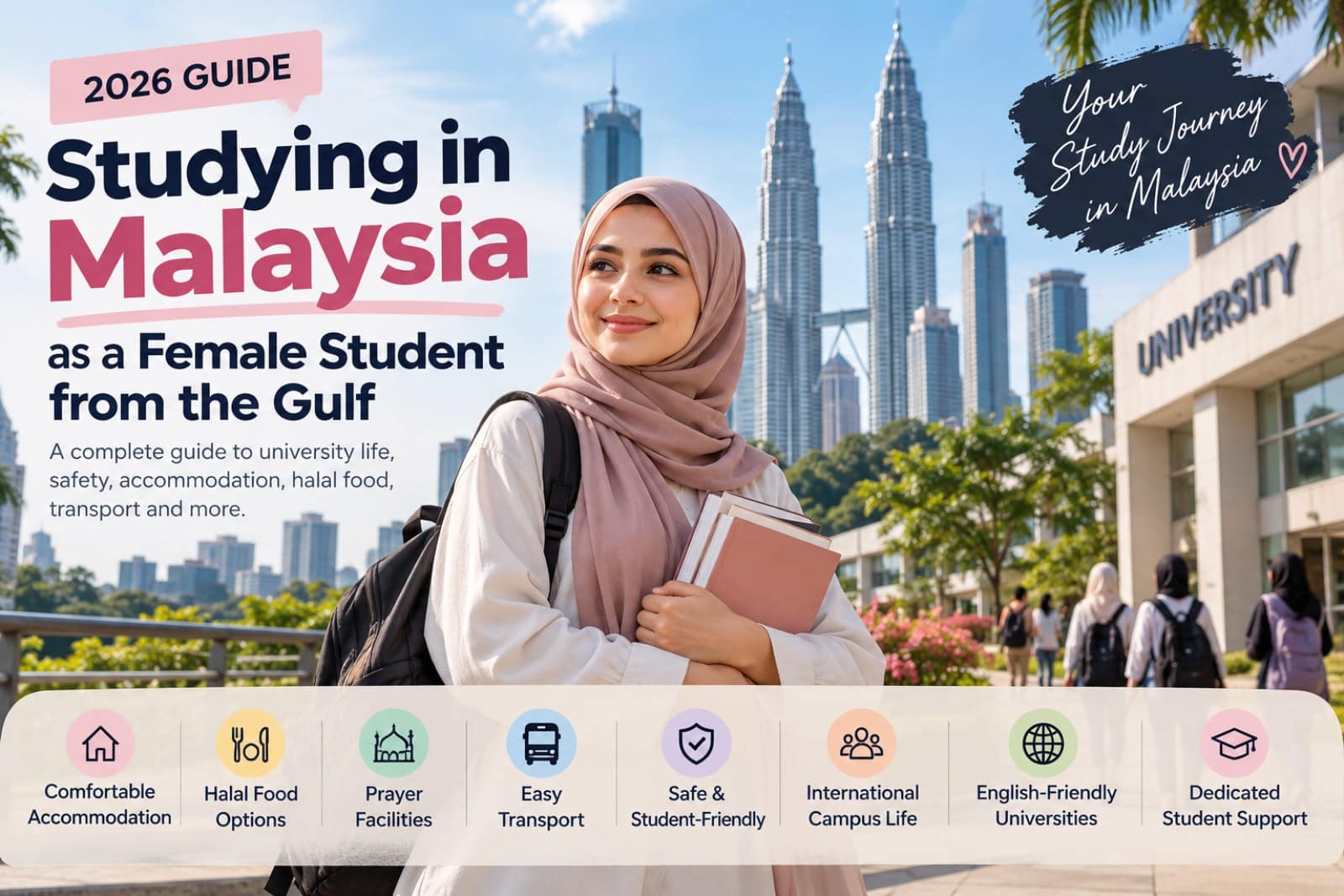
Female students in Malaysia can expect different accommodation options, easy access to halal food and prayer facilities, and convenient transport around major student areas.
Universities are generally international, English-friendly and supported by dedicated student services, which can make the transition easier for students arriving from abroad.
Life in Malaysia for Female Gulf Students
One of Malaysia’s strengths is the balance between cultural familiarity and international exposure.
Students study alongside Malaysians and international students from the Middle East, Asia, Africa, Europe and many other regions. English is widely used in higher education, especially at private universities and international branch campuses.
Outside the classroom, Malaysia is multicultural. Students experience Malay, Chinese, Indian and international communities living and studying together.
For Muslim students, many parts of everyday life are already familiar. Halal food · Mosques · Prayer rooms · Modest clothing · Ramadan-friendly environments are all easy to find.
This can make the adjustment to studying abroad more comfortable without taking away from the experience of living in another country.
Safety and Everyday Life
Safety is naturally one of the first concerns for students and their families.
Malaysia is generally manageable for international students, but the same everyday precautions that apply in any major city are still important.
Students should use reliable transport, avoid isolated areas late at night, keep personal belongings secure and become familiar with the area around their university and accommodation.
For families, it is useful to look beyond the general question of whether a city is safe. The student’s actual daily routine matters more.
Consider: distance from accommodation to campus · transport options · building security · access control · nearby supermarkets · clinics · restaurants.
A well-located residence can make daily life much easier.
Malaysia’s national emergency number is 999. Students should also save their university security and accommodation contacts after arrival.
Accommodation for Female Students
Accommodation can have a major impact on a student’s first experience in Malaysia.
Depending on the university and location, students may choose from on-campus residences · university-managed accommodation · private student residences · shared apartments · private apartments.
Some universities and private residences also offer female-only halls, floors or units. Availability differs between institutions, so students should always confirm the exact residence before booking.
For students moving abroad for the first time, accommodation on or close to campus can be a practical choice during the first year. It keeps classes, university services and student support nearby while the student becomes familiar with the city.
Before paying a deposit, check:
- Female-only or mixed residence
- Security and building access
- Distance from campus
- Visitor policies
- Internet and utilities
- Kitchen facilities and laundry
- Public transport nearby
- Deposit terms
Students renting privately should also verify the property and the landlord before making any payment.
Dress, Hijab and Campus Expectations
Malaysia is culturally diverse, and female students will see many different styles of clothing.
Hijab is not generally compulsory for international female university students.
Students who wear hijab, abaya or modest clothing are unlikely to find it unusual in Malaysia because modest dress is common. At the same time, students from different backgrounds may dress differently.
Universities can still have their own dress codes, especially for laboratories, clinical placements, internships, presentations, examinations and official university events.
Professional programmes such as Medicine, Pharmacy, Nursing, Engineering and Hospitality may also have specific clothing or safety requirements.
The best approach is to check the rules of the individual university and programme.
Halal Food and Prayer Facilities
For Muslim students, access to halal food is usually one of the easier parts of living in Malaysia.
Halal food is widely available around university areas, shopping malls, restaurants and supermarkets. Students can choose from Malaysian, Arabic, Indian, Turkish, Indonesian, Western and other international cuisine.
Prayer facilities are also common. Universities normally provide a surau, prayer room or nearby mosque, while prayer facilities can also be found in airports, shopping malls and many public buildings.
For students from the Gulf, this can make maintaining everyday religious routines much easier.
Transport and Getting Around
Students studying in Kuala Lumpur and parts of Selangor have access to a wide range of transport options: MRT · LRT · public buses · university shuttle buses · Grab and other e-hailing services.
Some rail services also provide women-only coaches.
Transport options may be more limited at campuses outside central Kuala Lumpur, so accommodation should always be considered together with the university location.
A cheaper apartment may not actually be the better choice if it requires a long commute or high daily transport costs.
For many students, living close to campus or near a university shuttle route can be more valuable than choosing accommodation based only on rent.
Living Independently as an International Student
For some Gulf students, studying in Malaysia may be their first experience living away from family. The adjustment is not only academic.
Students also begin managing monthly expenses, transport, groceries, laundry, appointments, university administration, healthcare and daily planning.
The first few weeks may feel unfamiliar, but good preparation before arrival can make the transition much smoother.
Students do not need to become fully independent immediately. University staff, friends, family and education counsellors can all remain part of the support system while the student becomes more comfortable.
University Life and Building a Community
University life in Malaysia extends well beyond lectures.
Most universities offer student clubs, sports, cultural societies, volunteering, professional associations, international student activities and university events.
Joining even one or two activities can help new students meet people and build a support network during their first semester.
Female Gulf students may also meet other Arab and Muslim students on campus, particularly at universities with large international student populations.
There is no single correct way to experience university life. Some students prefer an active social environment, while others are more comfortable focusing on classes and maintaining a smaller circle of friends. Both are completely normal.