

If you are coming to Malaysia as an international student, getting your university offer is only the first step. Before travelling, you need approval known as an electronic Visa Approval Letter (eVAL) for a Student Pass through EMGS and the Malaysian Immigration Department.
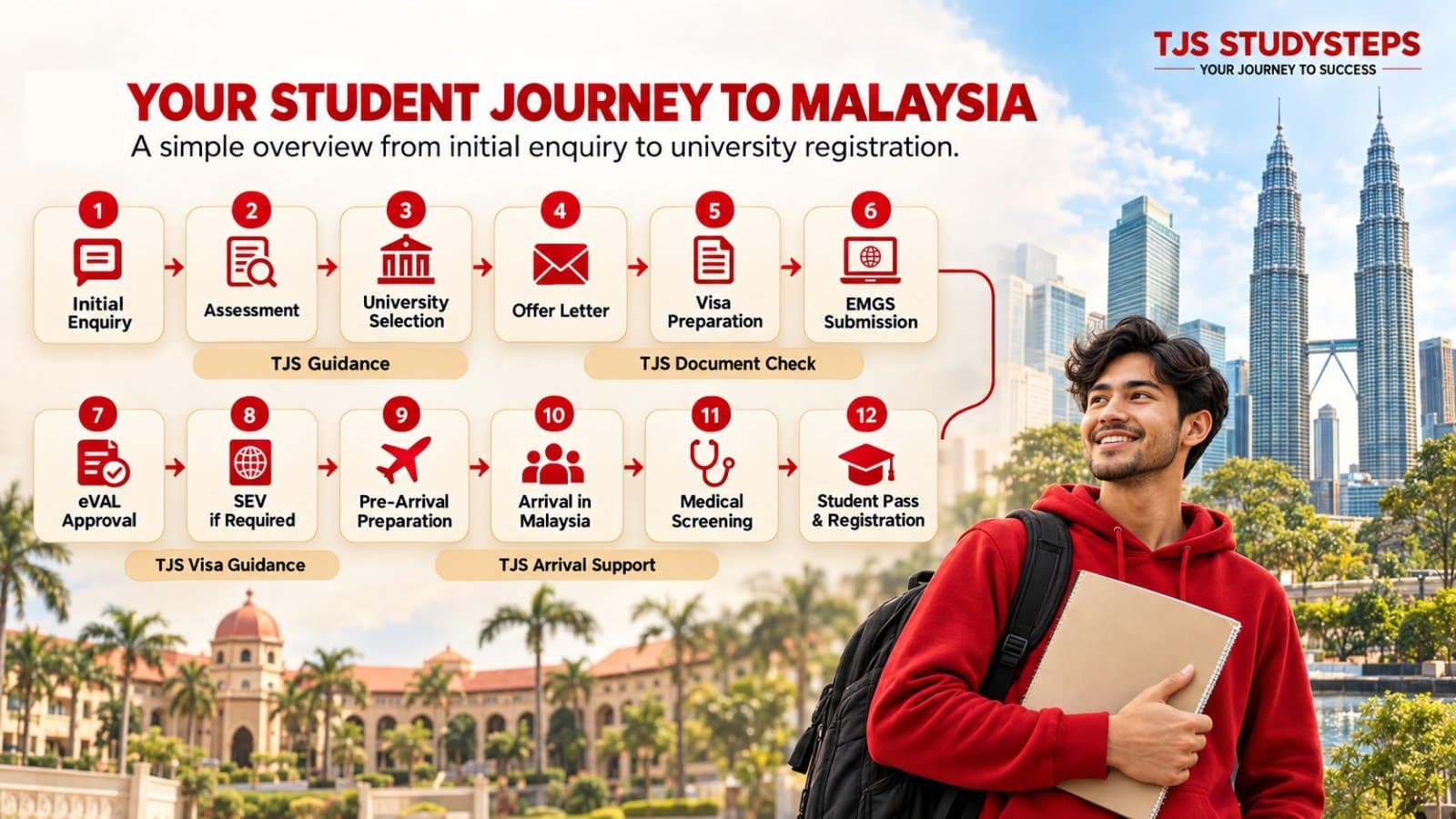
The process is easier to understand when you break it into stages: get your offer, prepare your documents, submit your Student Pass application, receive your eVAL, obtain a Single Entry Visa (SEV) as a student if required, travel to Malaysia, complete your medical screening, and finish the Student Pass endorsement.
This guide explains the complete Malaysia student visa process in simple steps, including the documents you need, how long EMGS processing can take, what eVAL and SEV mean, and what you need to do after arriving in Malaysia.
Malaysia Student Visa: Quick Summary
| What You Need to Know | Quick Answer |
|---|---|
| Visa system | Student Pass through EMGS |
| When can you apply? | After receiving an offer letter from a Malaysian institution |
| Passport validity | Minimum 18 months for a new Student Pass application |
| EMGS processing | 14 working days as per EMGS guidelines |
| eVAL validity | 6 months from the date of issue |
| SEV | Single Entry Visa, required for students from certain countries |
| Medical screening | Within 7 working days after arrival |
| Student Pass | Endorsed after arrival and medical clearance |
| Insurance | Mandatory throughout your studies |
EMGS states that its client charter is 14 working days for a complete Student Pass application, but this is not a guaranteed total processing time. Missing documents, additional checks and approvals from other authorities can extend the process.
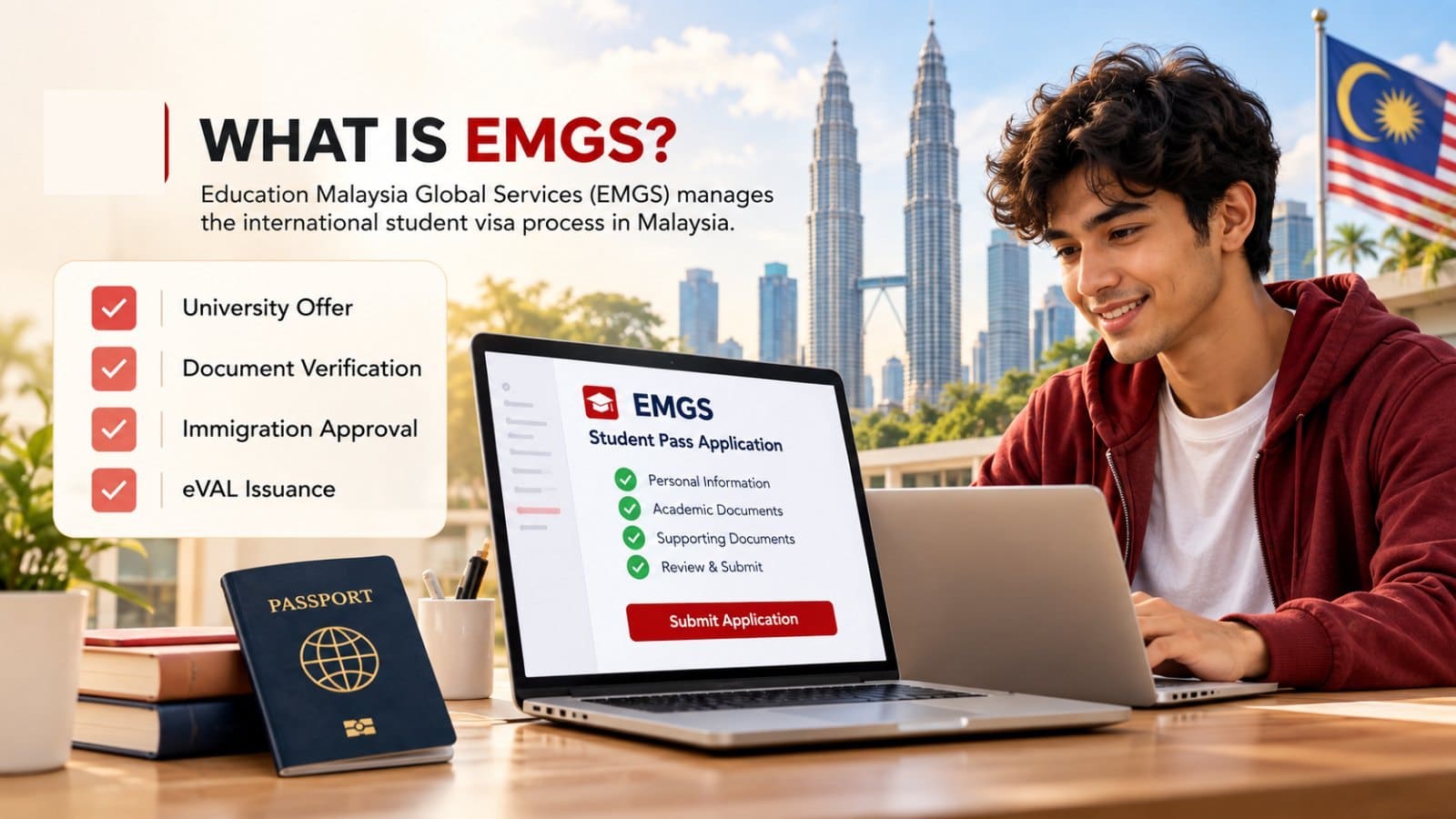
What Is EMGS?
EMGS stands for Education Malaysia Global Services. It is a company under the purview of Malaysia’s Ministry of Higher Education and manages services connected to international student visa applications in Malaysia.
Students often hear several visa terms during the process. They are related, but they do not mean the same thing.
- Student Pass is the immigration pass that allows you to stay in Malaysia for your studies.
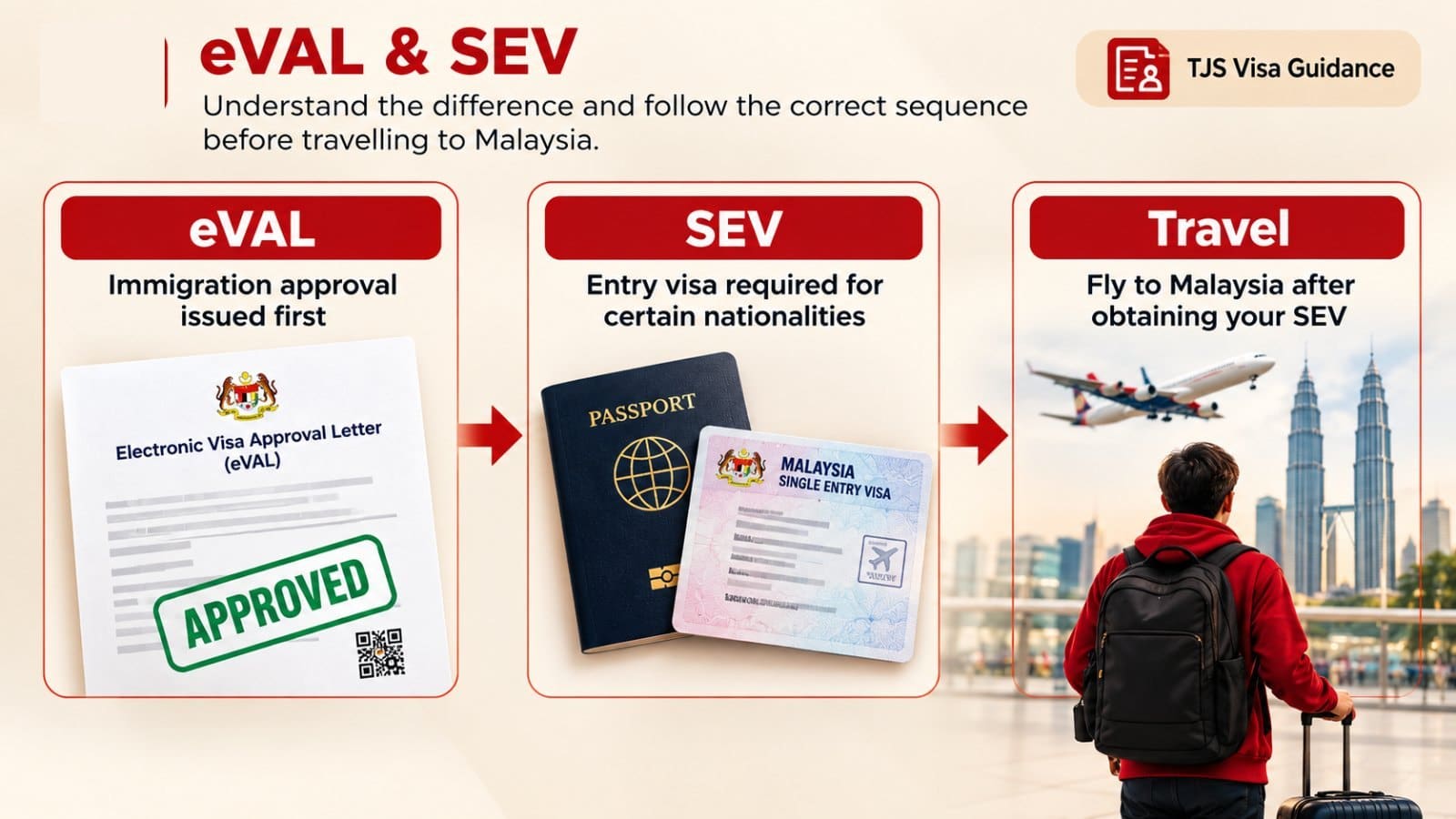
- eVAL means Electronic Visa Approval Letter and is the approval issued by the Malaysian Immigration Department for you to enter Malaysia as a student.
- SEV as student means Single Entry Visa and is required for students from certain nationalities before travelling to Malaysia.
The easiest way to remember the journey is:
University Offer → EMGS Application → eVAL → SEV if required → Travel → Medical Screening → Student Pass
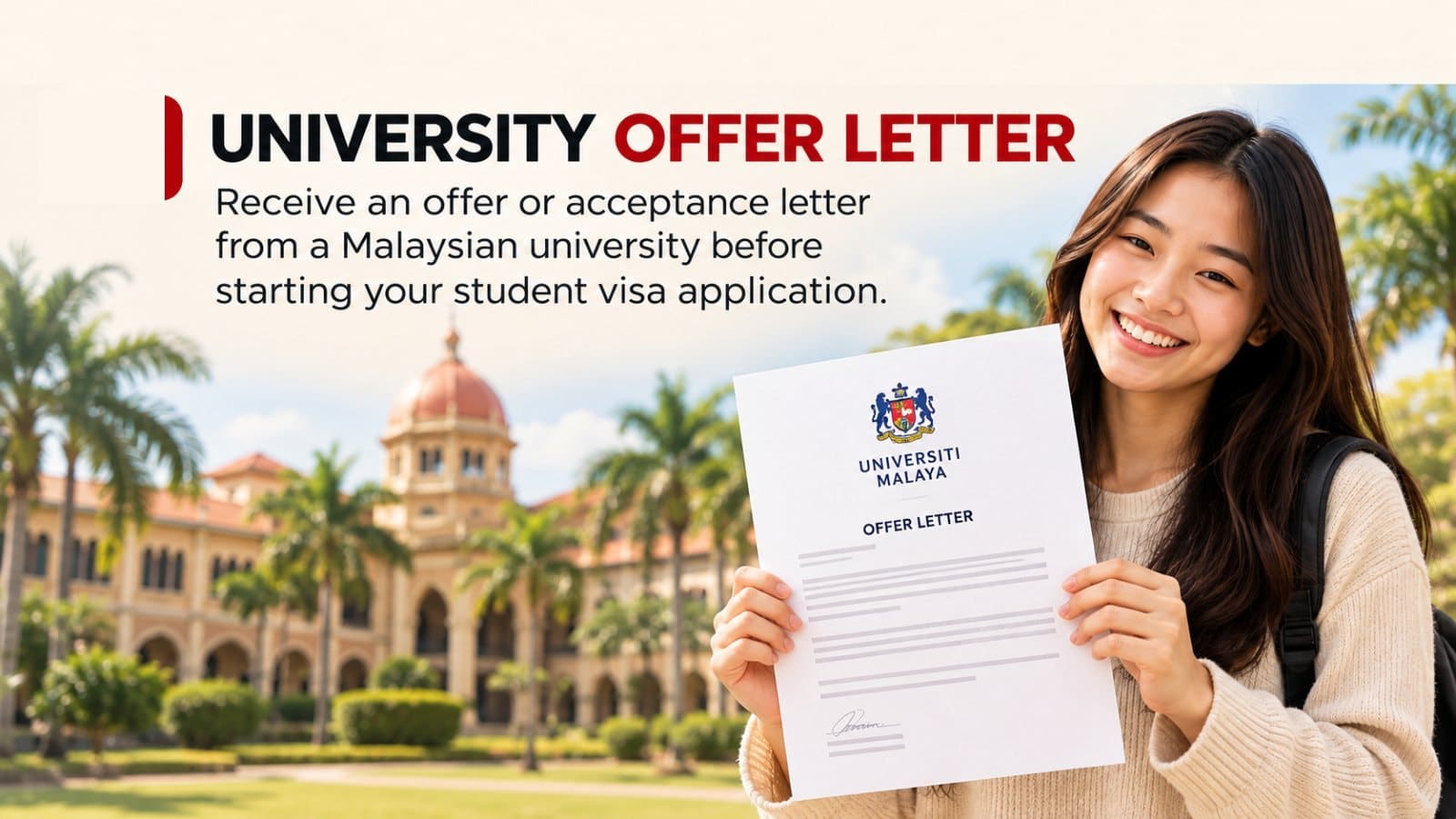
Receive Your University Offer Letter
You need an offer or acceptance letter from a Malaysian university or college before you can proceed with a new Student Pass application. EMGS lists the offer letter as one of the required documents for the application.
Read your offer letter before accepting it. Check the programme name, intake, campus, tuition fees and any conditions you still need to meet.
Our student counsellors would also explain these details during their online sessions with you.
Prepare Your EMGS Documents
Once your admission is confirmed, start preparing the Student Pass documents.
Do not wait until the last minute. A missing passport page, unclear scan, incomplete form, or discrepancy in names can slow down the application, sometimes putting your preferred intake at risk. If the name on your academic documents differs from the name on your passport, you may be required to provide an affidavit or declaration letter confirming that both documents belong to the same individual.
Your documents should be clear, complete and consistent. Make sure your name is written consistently across your passport, academic certificates and other official documents.
Use good-quality scans. Blurred, cropped or incomplete documents are among the most common causes of delays.
Documents Required for a Malaysia Student Visa
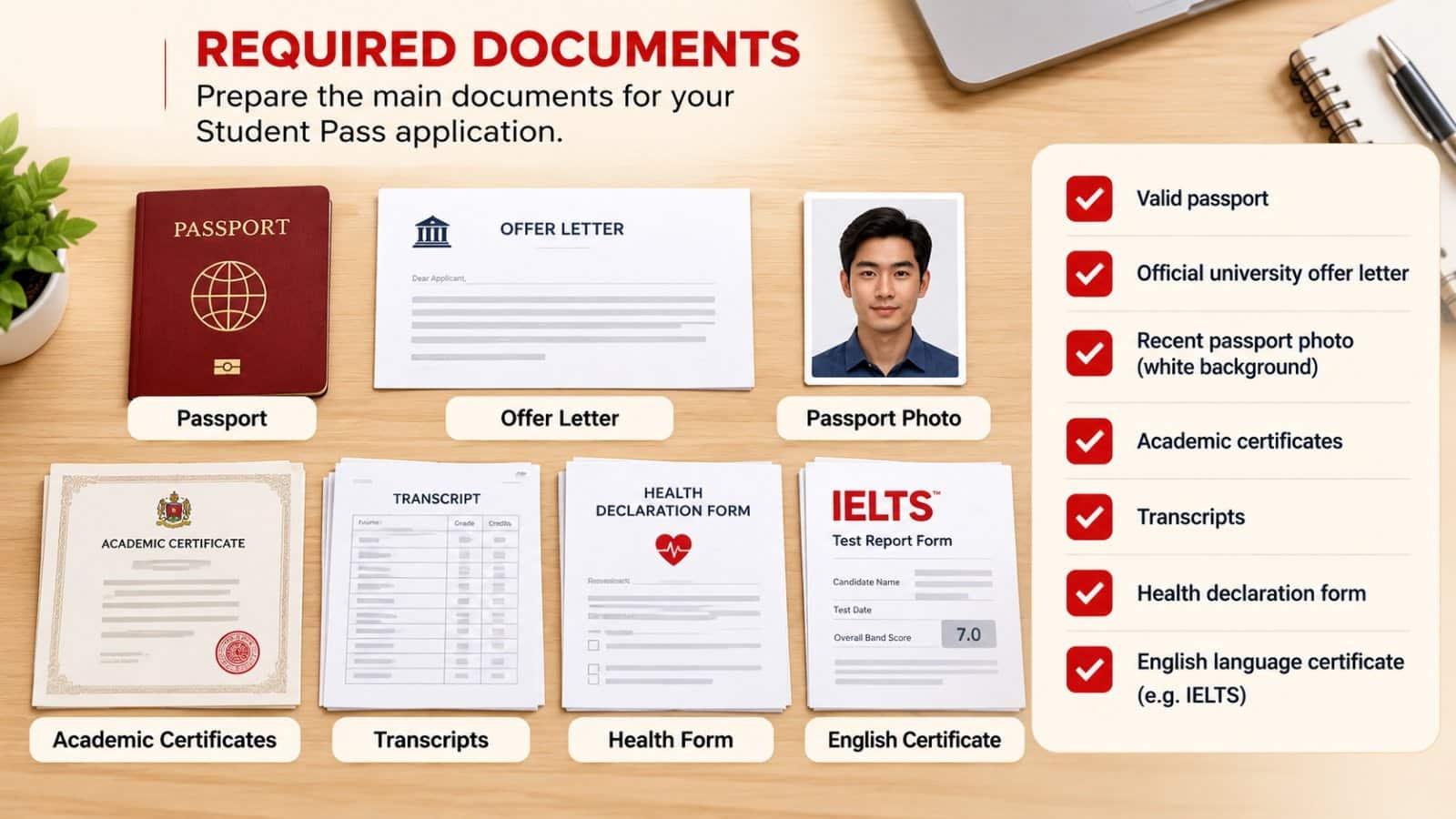
For a new Student Pass application, the main documents include:
| Document | What to Prepare |
|---|---|
| Passport photograph | White background, 35mm x 50mm |
| Passport | More than 18 months at the time of visa application submission |
| University offer letter | Issued by your Malaysian institution |
| Health Declaration Form | Completed and signed as required |
| Academic transcripts & completion certificates | Complete academic records |
| English language proficiency certificate | Required where applicable, such as IELTS, TOEFL or an MOI letter |
| Yellow fever certificate | Required where applicable |
| Personal Bond | Managed with your institution |
| Additional documents | May depend on nationality, university or location |
Passport Requirements for EMGS
For a new Student Pass application, your passport must have at least 18 months of validity.
For one-off Student Pass applications, EMGS recommends having passport validity approximately 12 months longer than the study duration. For example, for a 36-month programme, a passport valid for around 48 months is recommended. However, this is available only to certain nationalities, and you must check with the university or a TJS StudySteps counsellor whether you are eligible.
Your university may still ask for a complete passport scan, so prepare the full passport clearly in one file where requested.
EMGS Passport Photo Requirements
Your visa photograph needs to follow the EMGS specifications.
The required size is 35mm x 50mm, with a plain white background. The image should be in colour, properly lit and professionally taken. EMGS advises against selfies, filters or digitally altered photographs.
The same photograph may also be used for immigration records and your i-Kad, so getting it right at the beginning can prevent delays.
Do You Need IELTS for the Malaysia Student Visa?
You may need to show proof of English proficiency, but IELTS is not the only accepted test.
EMGS currently accepts English qualifications including MUET, IELTS, TOEFL iBT, TOEFL Essentials, PTE Academic, Cambridge English qualifications, Linguaskill, OET and ELS CIEP. Your university determines the score required for your programme.
EMGS also warns that failing to attach the required English certificate to the VAL application can delay processing and may affect the duration of the Student Pass issued.
Always follow the English requirement stated by your university for your exact programme. For a full breakdown by university, read our guide to whether you need IELTS to study in Malaysia.
Submit the Student Pass Application
After the required documents are ready, the Student Pass application is submitted by the university or TJS StudySteps to the EMGS portal.
EMGS reviews the application, academic information and supporting documents. If something is missing or needs clarification, additional information may be requested.
Even one document objection or correction can create a significant delay, so accuracy at the first submission matters.
How Long Does EMGS Processing Take?
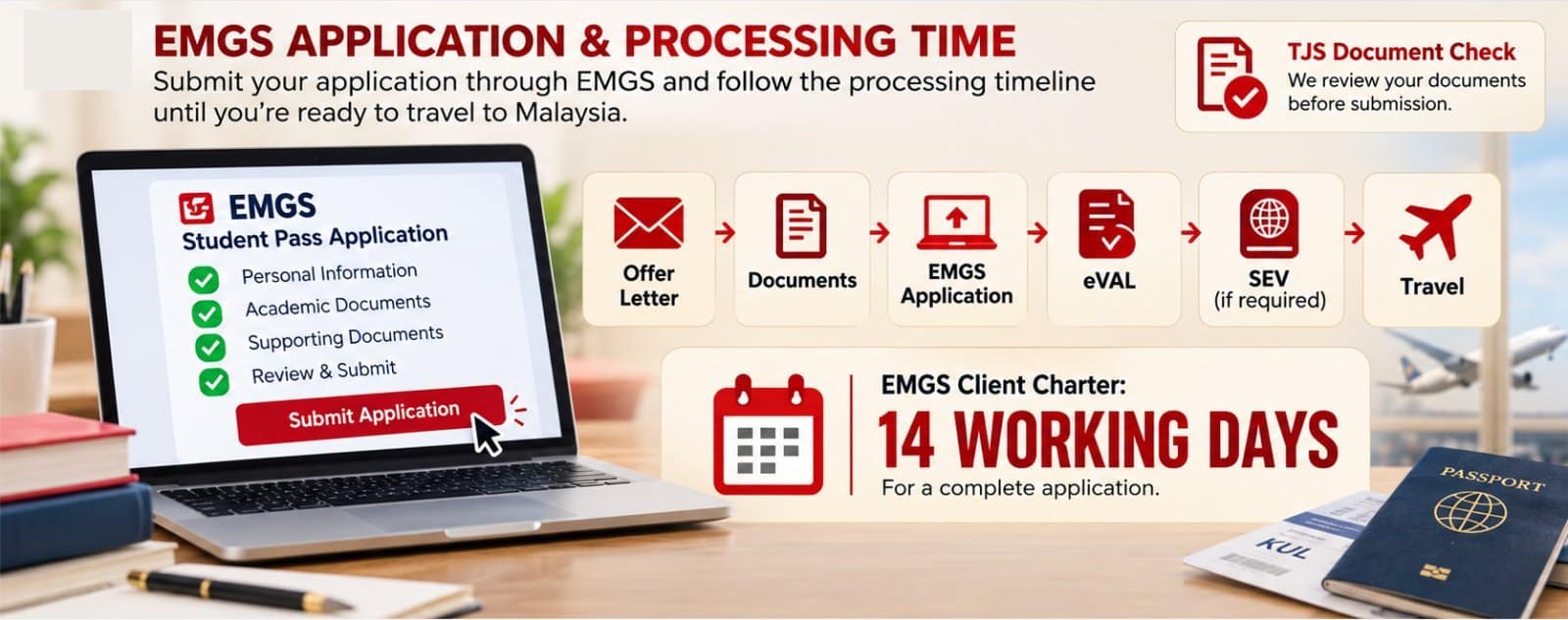
EMGS currently has a 14-working-day client charter for a complete Student Pass application.
That does not mean every student will receive the full visa process in exactly 14 working days. Processing can take longer when documents are incomplete, corrections are required or another government authority needs to give approval.
A realistic student visa timeline looks like this:
| Stage | Timeline / Requirement |
|---|---|
| University admission | Depends on university and programme |
| Complete EMGS application | 14 working days client charter |
| Additional document request | Adds extra processing time |
| eVAL | Issued after Immigration approval |
| SEV | Separate process if your nationality requires one |
| MDAC | Complete shortly before arrival |
| Medical screening | Within 7 working days after arrival |
| Student Pass endorsement | After medical clearance |
Keep extra time in your travel plans. Timelines can change if the university, EMGS or Immigration request amendments or additional documents.
Track Your EMGS Application
Once your Student Pass application has been submitted, you can track its progress through the official EMGS website or the EMGS mobile app for easier access to updates.
- Track online: EMGS application status
- Download the EMGS mobile app: EMGS on Google Play
Not sure how to track your application or understand your status? Contact TJS StudySteps and our team will help you.
Receive Your eVAL
Once the Malaysian Immigration Department approves the application, the student receives an Electronic Visa Approval Letter (eVAL).
The eVAL proves that Immigration has approved you to proceed with entry into Malaysia for your studies. The eVAL is valid for six months from the date of issuance.
Do not travel to Malaysia for your studies while the eVAL is still being processed. Education Malaysia states that a new student may enter Malaysia only after the eVAL has been issued.
If your passport is detected to be in Malaysia during the eVAL process, the Immigration Department may pause the approval process and instruct you to leave the country before restarting the visa process.
Do You Need a Single Entry Visa (SEV)?
Some international students need one more step after receiving the eVAL.
A Single Entry Visa (SEV) is required for students from specific countries before entering Malaysia. It is obtained after eVAL approval and before travelling.
The list of countries requiring an SEV includes Saudi Arabia, Qatar, Bahrain, Kuwait, Oman, the UAE, Pakistan and India, among many others. Since the list can change, always check the official EMGS list of SEV-required countries before travelling.
When an SEV is required for study, the application should be made using your student and eVAL information.
Do not enter Malaysia as a tourist for your study. Education Malaysia’s current guidance requires new students to receive their eVAL first and obtain an SEV where applicable before entering Malaysia for study.
Additional Documents for Certain Nationalities
Some applicants have extra conditions to be fulfilled based on nationality. Students applying to institutions in Sarawak may also have additional requirements such as an authorisation letter, cover letter and pre-VAL medical report where applicable.
Prepare Before Travelling to Malaysia
Once your eVAL and SEV, if required, are ready, prepare for arrival.
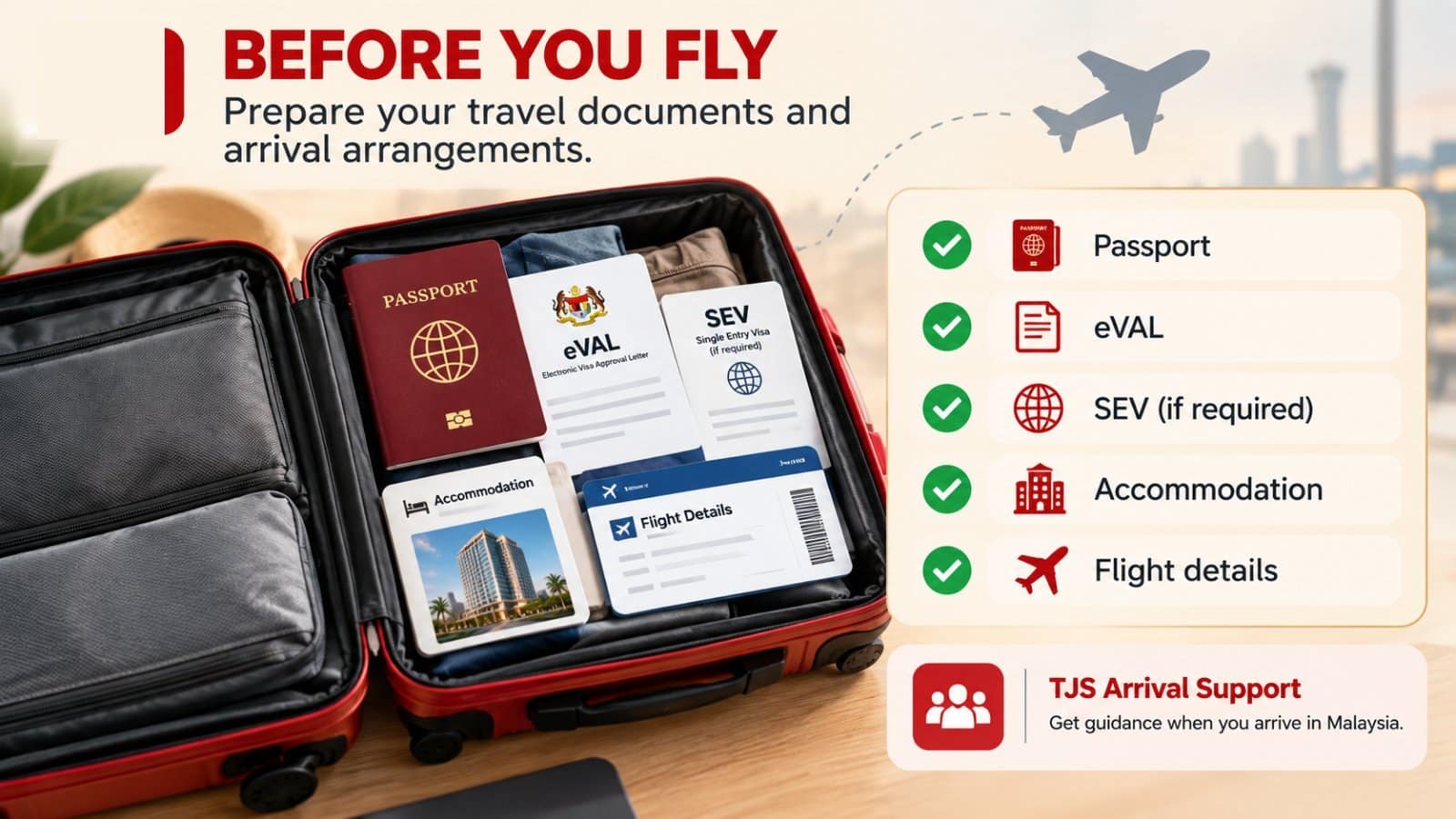
Before travelling, make sure you have arranged your accommodation, booked your flight and informed the university as well as your TJS StudySteps counsellor of your arrival.
Notify TJS StudySteps and the university of your flight details at least five days before arrival, especially where arrival clearance or airport pickup needs to be arranged.
What Documents Should You Carry to Malaysia?
Do not keep everything only on your phone. When travelling, carry your key documents in your hand luggage.
The official EMGS arrival guide lists the following among the important arrival documents: original passport, Visa Approval Letter / eVAL, Single Entry Visa if required, and yellow fever vaccination certificate where applicable.
Also bring your original academic documents, Health Declaration Form, arrival documentation and other documents used during admission and the visa process. Carry both the originals and printed backup copies.
Arrive in Malaysia
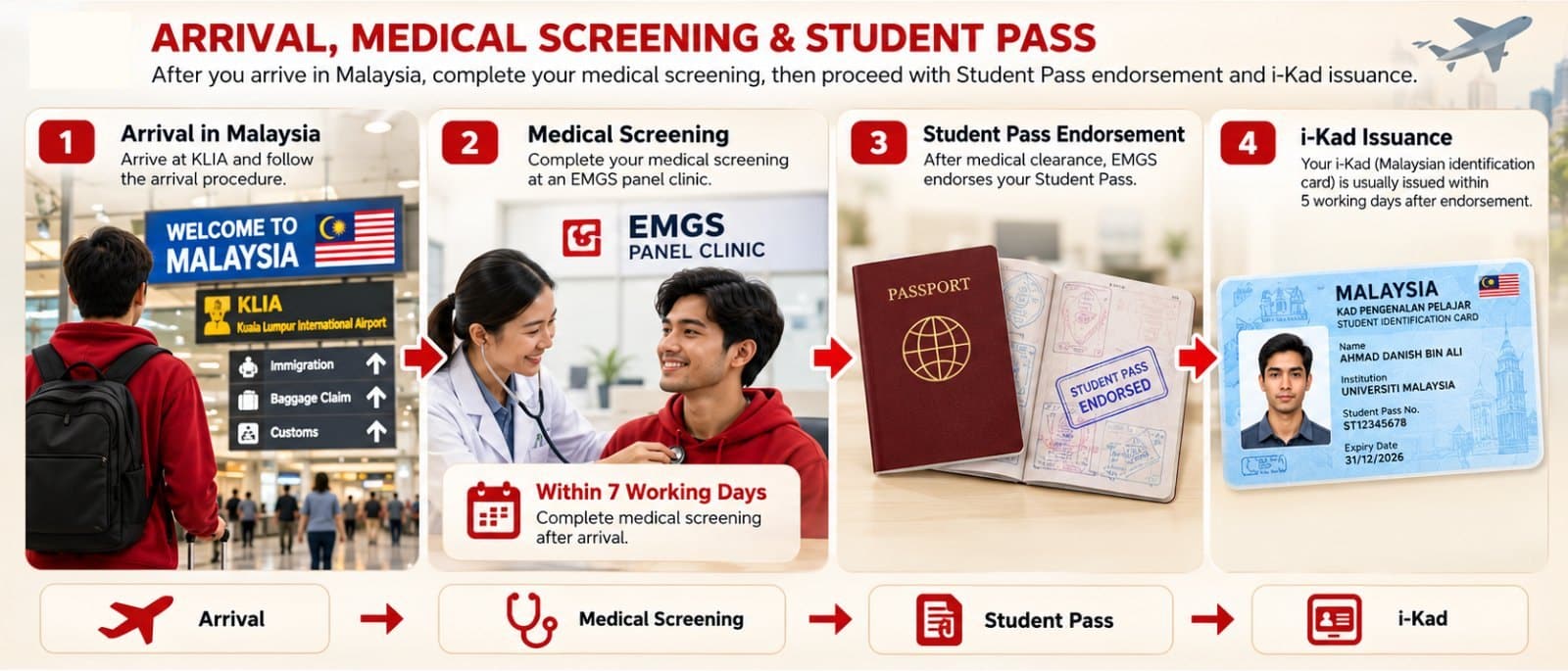
When you arrive, follow the international-student arrival procedure and present the required student documents to Immigration.
At KLIA, EMGS operates the International Student Arrival Centre (ISAC), where international students can receive assistance during arrival.
Make sure the university or relevant representative has your arrival information where required.
Complete Your Medical Screening
The visa process is not finished when you enter Malaysia.
New international students must complete an in-country medical screening at an approved EMGS panel clinic within 7 working days after arrival.
EMGS states that Student Pass endorsement cannot proceed until the new student has completed the required medical screening.
For students at public universities, screening may also be available at an approved university in-house clinic.
If a student fails the medical screening, the EMGS FAQ says an appeal may be submitted at the same EMGS panel clinic within three days of receiving the result.
Student Pass Endorsement and i-Kad
After you successfully complete the medical screening, your institution proceeds with the final Student Pass endorsement process.
The Student Pass endorsement is the stage where the Student Pass is issued in your passport after arrival.
The official EMGS arrival guide states that after medical clearance, EMGS requests the passport through the institution for Student Pass endorsement. It also indicates that the i-Kad is issued within five working days after the Student Pass endorsement.
The Student Pass is usually issued for up to one year at a time, with renewal subject to the required conditions and the approved duration of study.
Is Medical Insurance Required?
Yes. EMGS states that all international students entering Malaysia must have locally purchased medical health insurance throughout their study period.
The insurance normally begins from your date of entry when the required arrival information is provided to the institution. Your university and the EMGS process will guide you through the available approved insurance options.
Common Reasons for EMGS Visa Delays
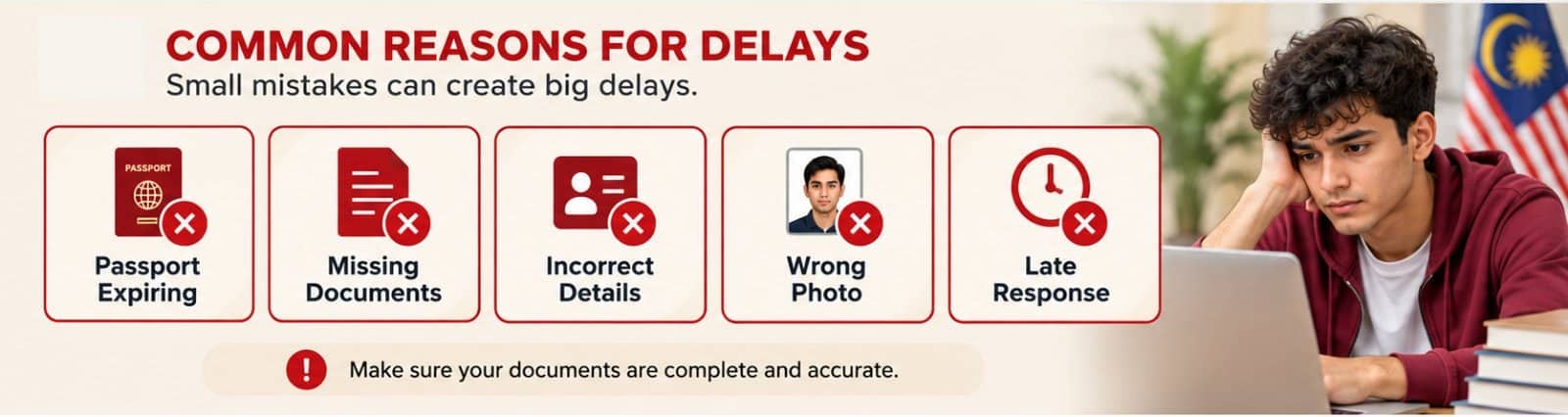
Many visa delays happen because the application needs to be corrected after submission.
Common problems include unclear passport scans, insufficient passport validity, missing academic records, incomplete forms, inconsistent names across documents, missing English-language evidence and slow responses to additional-document requests.
Students should also avoid submitting multiple applications through different representatives. Multiple applications can create delays and may cause problems with the university or visa process.
The best approach is simple: submit one accurate application with complete documents and respond quickly when anything additional is requested.
Malaysia Student Visa Checklist
Before submitting your application
- Your passport has enough validity (at least 18 months)
- Your passport photograph meets the EMGS requirements
- Your offer letter is correct
- Your academic certificates and transcripts are clear
- The Health Declaration Form is completed
- Any required English certificate is ready
Before travelling
- Your eVAL has been approved
- Your SEV has been obtained if required
- Your university has your arrival information
- Your accommodation is confirmed
- Your original documents are packed in your hand luggage
After arriving
- Complete your medical screening within 7 working days
- Follow your institution’s instructions for Student Pass endorsement
Frequently Asked Questions About the Malaysia Student Visa
How long does the Malaysia student visa take?
EMGS has a 14-working-day client charter for a complete Student Pass application. This is not a guaranteed total processing time, and additional checks or missing documents can extend the process.
Can I apply for EMGS without an offer letter?
No. A university or college offer letter is required before a new Student Pass application can be submitted.
How long must my passport be valid?
For a new Student Pass application, your passport must be valid for 18 months or more.
How long is an eVAL valid?
An eVAL is valid for six months from its issue date.
Can I travel to Malaysia while my eVAL is processing?
No. New international students should enter Malaysia only after the eVAL has been issued.
What nationalities require an SEV?
Students from certain countries are required to obtain a Single Entry Visa (SEV) before travelling to Malaysia after receiving their eVAL. Because visa requirements may change, always check the latest official EMGS list to confirm whether your nationality requires an SEV.
Is the medical screening compulsory?
Yes. New international students must complete medical screening within 7 working days after arrival.
Is medical insurance compulsory?
Yes. International students must have approved medical insurance during their studies in Malaysia.